AI systems are moving beyond simple text-based chat toward agents that can use tools, follow multi-step workflows, and take actions on a user's behalf. Reusable skills are one way to make these systems more consistent and specialized. In this article, we'll explain what they are, how they work, how they differ from tools, and how modular agent architectures are structured and used.
What Are Skills in AI Agents
In modern agent systems, a skill is a reusable set of instructions and resources designed to support a specific type of task more consistently. Depending on the platform, it may include workflow instructions, examples, reference materials, scripts, code, and guidance for or access to relevant tools.
The term "skill" is also sometimes used more broadly to describe model capabilities such as reasoning, planning, or communication. In this article, however, we use it in a narrower sense to describe reusable task-specific workflows that can be selected and applied when needed.
Common examples of tasks that can be packaged as agent skills include:
- Research and retrieval. Finding relevant information across the web, documents, databases, or other approved sources.
- Data analysis. Preparing, analyzing, and visualizing data according to a defined workflow.
- Content and document creation. Producing reports, summaries, presentations, emails, or other structured outputs using predefined requirements.
- Business process automation. Following repeatable multi-step workflows that may involve several applications or data sources.
- Communication. Handling recurring communication tasks such as drafting responses, adapting tone, or preparing structured updates.
- Domain-specific workflows. Applying specialized procedures for areas such as marketing, finance, customer support, research, or software development.
How AI Agent Skills Work
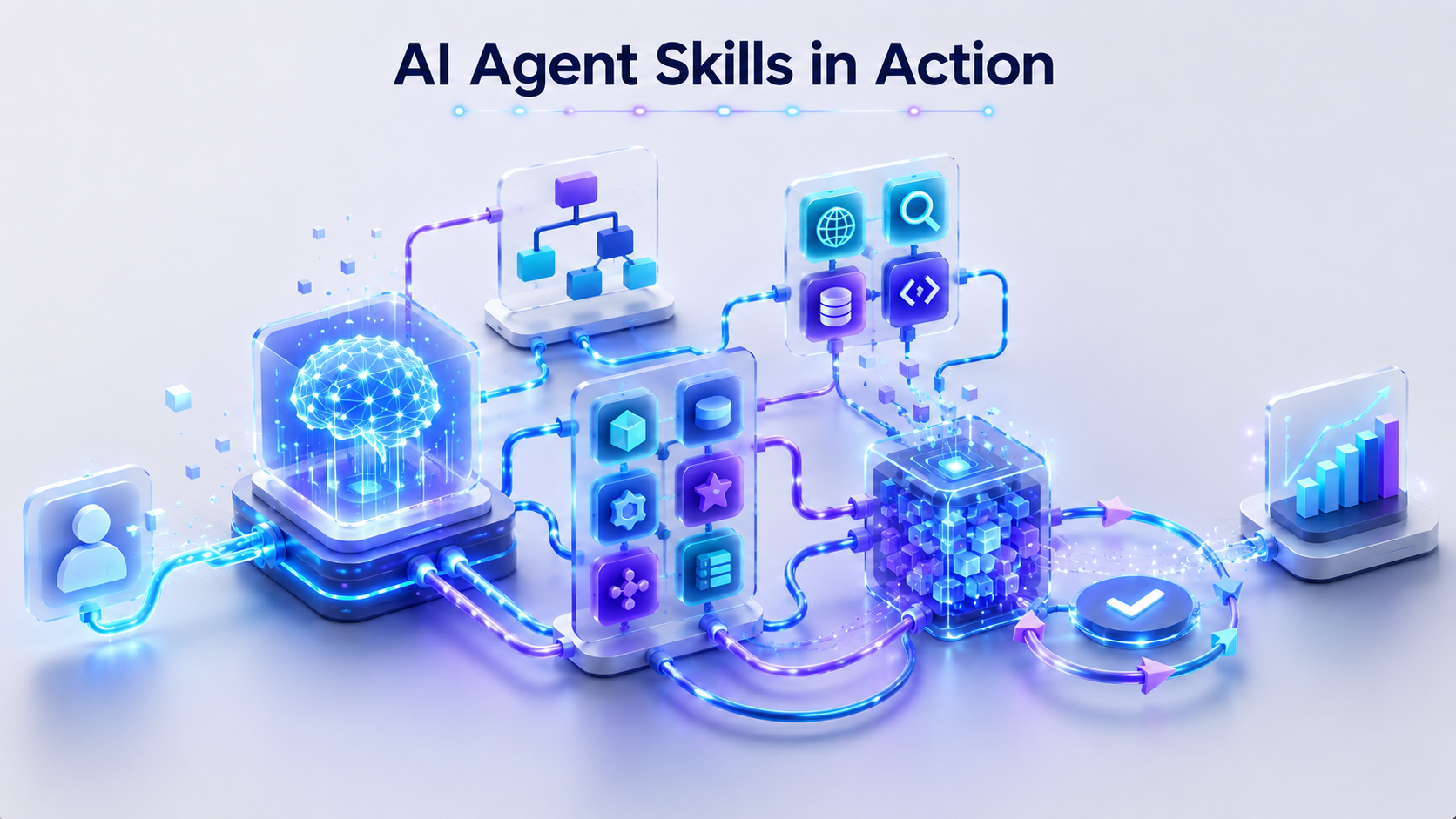
A useful way to think about agent skills is as reusable workflow modules that can be selected when they are relevant to the current task. Depending on the platform, a module may be triggered explicitly by the user or selected automatically by the system.
A simplified skill workflow can be described in three main stages:
- The agent interprets the task. It identifies the user's goal, relevant constraints, available context, and the expected output.
- The agent selects an appropriate skill or workflow. If a relevant skill is available, the agent can load its instructions and supporting resources and determine which tools may be needed.
- The agent executes the workflow. It follows the skill's instructions, calls tools where necessary, evaluates intermediate results, and produces the requested output.
In practice, these workflows do not always follow a strictly linear path. The influential ReAct (Reasoning + Acting) approach introduced by researchers from Princeton University and Google Research showed how interleaving reasoning with actions can help a model update its plan as it receives new information. Many modern architectures use similar iterative loops in which the system calls a tool, evaluates the result, and decides what to do next.
An agent skill can contain several components, depending on the platform and the complexity of the workflow. At its core, it usually provides instructions that define what the workflow is for and how a particular type of task should be handled. More advanced implementations can also include supporting resources, scripts, examples, or guidance for using external tools.
Name and description
The name identifies the skill, while the description explains what it does and when it may be useful. A clear description becomes especially important when several reusable workflows are available and the system needs to choose the most relevant one.
Workflow instructions
Instructions describe how the task should be performed. They may define individual steps, decision rules, constraints, formatting requirements, expected outputs, and common edge cases.
Supporting resources
Supporting resources can include templates, examples, reference documents, schemas, brand guidelines, or other materials that help keep task execution more consistent.
Scripts and code
Some workflows also rely on executable scripts for operations that are better handled programmatically, such as data transformation, calculations, file processing, or validation.
Tool guidance
When a workflow requires external capabilities, the skill can specify when and how relevant tools should be used. These may include APIs, databases, web search, file systems, business applications, or other services available within the environment.
Skills vs. Tools vs. Agents
Skills, tools, and agents are closely related, but they play different roles in an agentic AI system. Understanding the distinction is important when designing workflows that are reusable, reliable, and easy to maintain.
A skill defines how a particular type of work should be done. It packages a repeatable process that can be applied when a relevant task comes up. Depending on the platform, a skill may include instructions, examples, templates, reference materials, validation rules, scripts, and guidance on when to use particular tools. In simple terms, a skill answers the question: How should this task be performed?
A tool gives the agent a capability it can use while carrying out that process. Tools may allow an agent to retrieve information, run code, query a database, search the web, send an email, update a CRM record, work with files, or interact with another application. A tool answers a different question: What can the agent use or act on?
An agent brings these elements together. It receives a goal, interprets the available context, decides what steps are needed, applies relevant skills, and uses permitted tools to complete the work. Depending on the task, the agent may also evaluate intermediate results and adjust its next step before producing a final output or taking an action.
The difference becomes clearer with a practical example. Suppose an AI travel agent is asked to plan a budget-friendly trip to Japan.
A travel-planning skill could define how to:
- collect the traveler's dates, budget, interests, and other preferences;
- build a realistic itinerary without scheduling too many activities in one day;
- compare transportation and accommodation options against the available budget;
- organize routes, bookings, and recommendations into a clear final plan;
- check that the itinerary meets the user's original requirements before presenting it.
Carrying out that workflow may require several tools:
- airline and railway search or booking APIs;
- hotel booking services;
- online maps;
- weather data;
- currency conversion tools;
- databases or websites containing information about attractions and opening hours.
The skill provides the procedure, while the tools provide access to the information and actions required to follow it. The agent coordinates the process. If a hotel is unavailable or a train makes the original schedule impractical, for example, the agent can use new information from its tools to revise the plan rather than simply following the initial sequence.
This separation also makes the overall architecture easier to extend. The same tool can support different workflows, while a single skill may work with several tools that provide similar capabilities. Instead of hard-coding every task into one process, developers can combine reusable modules and tools according to the requirements of each workflow.
Building Modular Skills for AI Agents
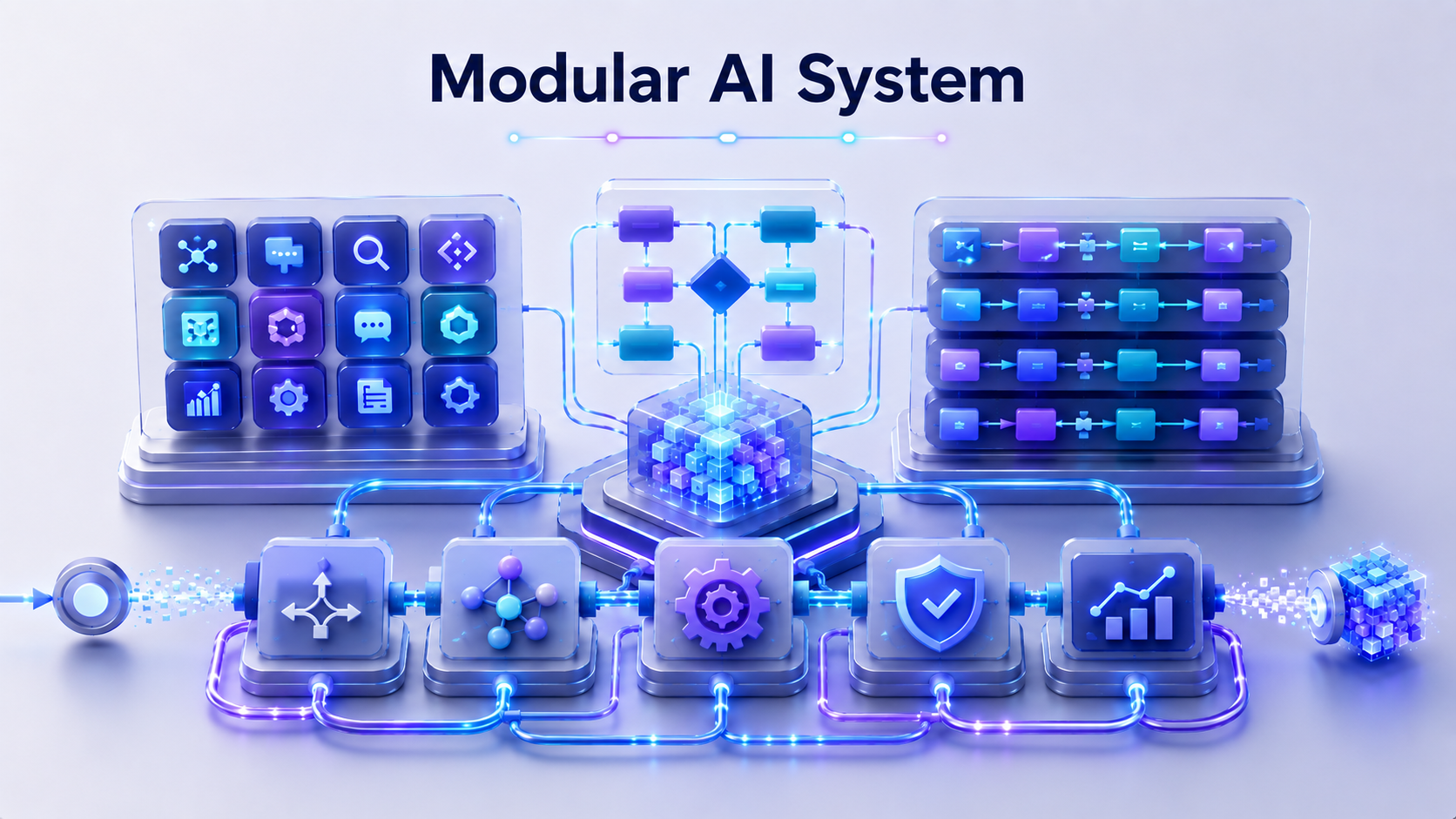
Modular AI systems can rely on reusable and composable skills. This structure makes it possible to select relevant modules from a library, combine them when necessary, and apply them to the task at hand instead of following one fixed prompt or process.
A modular agent system may include components such as:
- Library (registry). This is where all skills available to the agent are stored.
- Router. A component that helps identify which skill, workflow, or agent should handle a particular task.
- Orchestrator. A system component that enables AI to coordinate various skills during the execution of multiple workflows.
- Tools layer. This layer provides access to third-party APIs, applications, and other systems required during task execution.
- Validator. Checks the validity of the result before sending it to the user.
- Monitoring layer. Tracks the performance and other metrics of AI tasks and stores these metrics in logs.
Similar modular agent architectures can be built with frameworks such as LangGraph, CrewAI, and Microsoft Agent Framework. They provide different combinations of agent orchestration, tool integration, workflow control, memory, monitoring, and multi-agent coordination.
Building reliable modular agent systems requires a thoughtful approach to their design, configuration, and evaluation. Below are some practical recommendations to help improve the reliability of such solutions.
Start small
Don't try to create a complex, multi-component module with dozens of components right away. Start with one or a few clearly defined skills and a simple orchestration pattern. Add more components only when the workflow genuinely requires them.
Separate skills and tools
Learn to clearly distinguish skills from tools and apply them correctly. A skill defines how a task should be handled, while a tool provides a capability the agent can use to retrieve information or take an action.
Conduct continuous monitoring
In production environments, monitoring helps teams understand how modular workflows perform over time. Useful metrics may include skill usage and failure rates, token consumption, tool latency, incidents, and recurring output errors.
Use evaluation cycles
Continuously evaluate the performance of modular skills. Use benchmarks, regression tests, user feedback, adversarial prompts, and other evaluation methods.
Conclusion
Agent skills are becoming an important part of modern AI systems because they provide a reusable way to package task-specific workflows, instructions, and expertise. They help these systems follow established procedures more consistently and apply the right resources or tools when a task requires them.
A modular approach makes these workflows easier to reuse and extend. Relevant skills can be selected and combined when appropriate, while external tools provide access to information and actions. With careful design, monitoring, and evaluation, this approach can make agent systems more consistent and easier to maintain.