In 2026, AI is no longer just generating content — it's taking action. Agentic AI systems can plan, decide, and execute complex tasks autonomously, and marketing is one of the first functions to feel the impact. In our article, we'll discuss the promising and in-demand technology of AI agents. Learn about its key features, differences from Gen AI models, business benefits, and potential applications of agentic AI in marketing, as well as the current challenges and risks of such systems.
From Generative Outputs to Autonomous Actions: The Core Shift
Agentic AI is the next evolutionary step beyond generative AI. Where Gen AI responds to prompts, agentic systems go further — adding autonomy, multi-step planning, and the ability to act independently without continuous human guidance. In essence, an LLM serves as the “brain” of an agent system, while agent architectures equip it with tools, memory, and the ability to act — not just respond.
The active development and adoption of AI agents for business automation began several years ago. However, there are a number of fundamental differences between agentic AI and generative AI that are important to understand.
Generative models are designed to produce content in response to user requests: text, images, code, video, and other materials. They are capable of complex generalization and handling a wide range of creative and analytical tasks. However, their fundamental limitation is their reactive nature. GenAI systems rely on explicit instructions, process input data, and return a result. The quality of the response depends on the accuracy and completeness of the request, and the model itself does not take steps beyond the stated task.
AI agents operate with significantly greater latitude, enabling them to autonomously and proactively solve assigned tasks. These systems efficiently execute multi-step processes with only a basic set of instructions. They also apply reasoning and make decisions with incomplete or ambiguous input data.
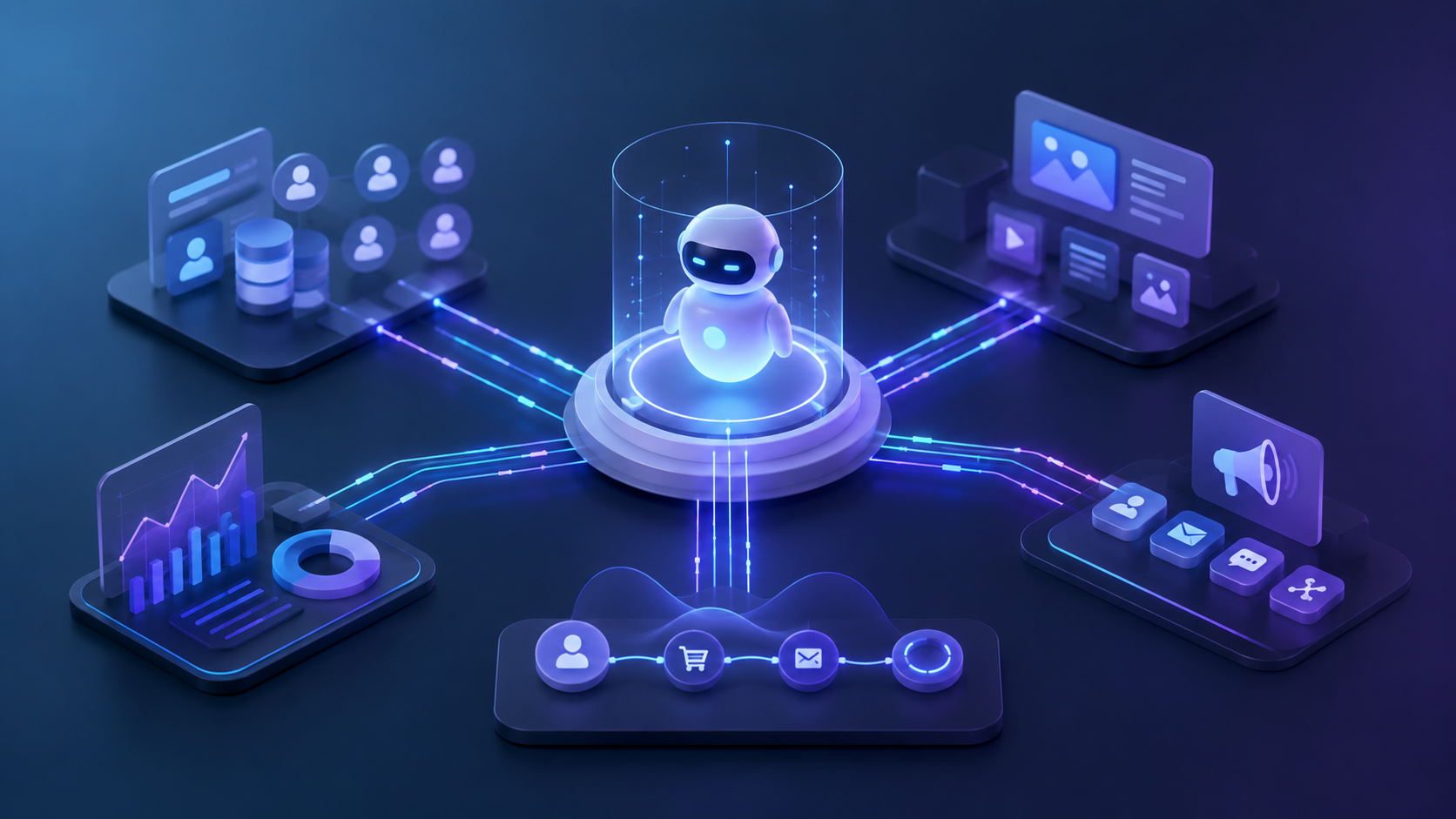
In practice, Gen AI is constrained by its predefined algorithm — it follows instructions, processes input, and returns output. Agentic AI operates much more autonomously and proactively. It can operate with greater autonomy once objectives are defined. This allows it to implement complex multi-stage tasks that are difficult or impractical for traditional generative models.
For example, when solving marketing problems, Gen AI can create text, images, videos, and other materials from input data. It can also analyze the results of marketing campaigns and generate insights based on them. AI agents not only perform these actions but also perform autonomous campaign management, plan and develop entire campaigns, select optimal promotion strategies, and solve other complex tasks.
High-Impact Use Cases: Marketing Agents in Practice
As AI agents move beyond experiments and become part of marketing teams' daily work, their value is best demonstrated through practical applications. These aren't isolated improvements, but rather system-level changes in how content is created, audience engagement is built, and campaigns are managed. Below are the key areas where marketing agents are already demonstrating the greatest impact and setting new productivity standards.
Content creation, optimization, and distribution
AI agents efficiently scale content generation, updating, and publishing across multiple channels. They can test various content options and select the best ones for further distribution.
Agents excel at content atomization — for example, turning a long-form article into a collection of posts and email newsletters, a webinar recording into a series of short videos, etc. They are also widely used for SEO and GEO content optimization.
Personalization and customer journey optimization
Thanks to AI agents, marketers can automate the dynamic personalization of content and other campaign parameters (offers, geolocation, timing) for different target audience segments. This allows them not only to more accurately meet user expectations but also to quickly adapt communications in response to changes in their behavior and context.
Agents have proven effective in developing and managing AI-driven customer journeys. They can be used across multiple channels such as email, SMS, and mobile apps in real time, based on behavioral and other patterns.
Lead scoring and sales support
Agentic AI automatically analyzes and scores potential customers in real time within CRM systems based on their intent, behavior, and other factors. It helps route leads faster and more accurately, generates talking points for sales teams, and provides personalized follow-up recommendations.

- Automate the work with leads from the Facebook advertising account
- Empower with integrations and instant transfer of leads
- Don't spend money on developers or integrators
- Save time by automating routine tasks
Communication, service, and customer engagement
One of the most important tasks for AI agents in marketing is autonomous and proactive communication with audiences across all available channels simultaneously, in real time. AI models efficiently handle marketing and pre-sales interactions, act as assistants, answer questions, and resolve user issues. They also effectively engage audiences and take additional actions to enhance the customer experience.
Strategy execution and campaign management
Developing and optimizing AI-powered marketing strategies is a useful and a valuable capability businesses gain by implementing agents. They are capable of managing marketing campaigns end-to-end: autonomously planning, testing, launching, adjusting budgets based on signals, and analyzing campaign results.
The Strategic Edge: Efficiency, Scale, and Hyper-Personalization
The combination of automation depth and autonomous decision-making is what makes agentic AI genuinely transformative for marketing teams — not just a faster way to do the same things, but a fundamentally different operating model. As a result, companies gain not just an automation tool, but a strategic resource capable of simultaneously increasing the speed, scalability, and accuracy of marketing operations.
By integrating AI agents into their technology stack, businesses gain significant benefits:
- Increased productivity. AI agents operate 24/7, handle multiple processes simultaneously, scale instantly, and retain and process large volumes of information. Furthermore, agent systems can reduce employee time spent on multi-step tasks — provided that processes are clearly defined and resource utilization is monitored.
- Comprehensive automation. Agentic AI automates business processes end-to-end, not just individual stages. This significantly speeds up cycle times, minimizing the need for micromanagement and the need to escalate tasks to human operators when needed.
- Fast and effective decision-making. AI agents instantly process data in real time, apply logical analysis, continuously adjust plans, and fine-tune processes. This dramatically speeds up the decision-making processes, helping businesses respond instantly to market changes.
- Cost optimization. Integrating autonomous marketing agents into workflows reduces errors and rework, requires fewer tools, and reduces staffing requirements, thereby reducing the company's operating costs.
- Improving customer experience. Agent systems proactively engage with customers, providing a personalized approach based on their goals, preferences, and previous interactions. This allows businesses to maintain a high-quality customer experience across all channels, increasing their CSAT and CLV.
- Cross-platform orchestration. AI agents coordinate their work across various business platforms: CRM, ERP, marketing tools, customer service/support systems, data warehouses, etc.
Navigating the Human-AI Collaboration: Guardrails and Ethics

As AI agents become part of the next generation of marketing, business attention is shifting from capabilities to issues of control, accountability, and long-term sustainability of these systems. Practical implementation requires understanding their potential and establishing clear constraints, oversight mechanisms, and ethical principles. This allows for the safe integration of autonomous models into marketing processes and helps avoid risks associated with advanced AI systems.
Privacy and security
The widespread use of AI agents in business significantly increases the risk of privacy breaches or unauthorized access to sensitive information. The high autonomy and proactivity of such models grant them greater operational agency than generative AI systems, potentially leading to major data breaches from company and organizational databases.
Anonymizing and containerizing sensitive data accessed by agent systems can help minimize the risk of such threats. When implementing these solutions in internal systems, they should be categorized by function or role, and their access levels should be restricted and controlled.
Quality and relevance of results
The accuracy, efficiency, and other performance criteria of AI agents depend not only on user instructions but also on the relevance and timeliness of the data they work with. Poor quality or incomplete input data reduces the potential of intelligent algorithms, which can significantly reduce their effectiveness.
Real-time data and streaming platforms such as Apache Kafka, Apache Flink, and Databricks help address this challenge. They enable continuous collection, processing, validation, and delivery of up-to-date information to AI models from multiple sources, eliminating the need to work with outdated or incomplete data.
Reliability and predictability
Generative AI models operate within a single request-response cycle and do not act beyond the scope of a given task. This simplifies their control: their scope of operation is limited, and the result is directly linked to a specific prompt. However, Gen AI is not immune to hallucinations, inaccurate interpretations, and inconsistent responses — especially when given vague or complex instructions.
Agentic AI relies far less on direct user control, making decisions and planning its actions independently. This increases its productivity and helps it perform more complex tasks but also creates the risk of unpredictable and uncontrolled actions.
Ethical issues
The high performance and autonomy of AI agents may result in assigning them an excessive level of responsibility, primarily related to the management of critical processes. The consequences of erroneous or malicious actions by artificial intelligence may cause large-scale operational, financial, or societal harm.
To prevent such a scenario, it is necessary to implement effective controls over the actions of AI agents. Continuous monitoring, performance evaluation, and maximum transparency in interactions with them are key. In 2026, these requirements have moved beyond ethical guidelines — they are now codified into law.
Final Thoughts
AI agents are one of the most promising trends shaping the future of AI in marketing in 2026. Their autonomy, proactivity, and ability to efficiently solve various complex problems and find innovative solutions make them extremely useful for businesses.
The ability of AI agents to operate efficiently and deliver desired results without human micromanagement has driven a major breakthrough in the development of artificial intelligence and its application across numerous industries. However, with this increased freedom of action comes equal responsibility, requiring developers and users of AI agents to implement adequate monitoring and control of such systems.