While vector similarity search techniques have existed for decades, dedicated vector databases have experienced a massive surge in popularity in recent years amid the boom in AI applications. In this article, we'll explain what a vector database is, how it works, and how it differs from a relational (SQL) database. You'll also learn about the applications of vector databases, popular providers, and selection criteria.
The Core Concept: How Vector Databases Differ from SQL
Vector databases (VDBs) are a type of database designed for storing and retrieving special types of data called vector embeddings. Embeddings are numerical vectors that can represent various types of data, including non-mathematical data (text, images, video, audio, etc.).
Embeddings stored in VDBs are currently the most suitable and widespread format for organizing unstructured data when processed by large language models (LLMs), which form the foundation of the AI infrastructure. LLMs represent text and other data as multidimensional vectors in a latent space. This makes traditional relational databases less effective for similarity-based retrieval tasks.
The specifics of handling embeddings and similarity search have led to the development of specialized vector databases. Compared to traditional SQL systems, they use a different approach to data organization, indexing, scaling, and query execution.

Data model and structure
The fundamental unit of data in the VDB is a multidimensional vector, typically comprising 384 to 4096 or more dimensions, created using an embedding model. This allows for the placement of "similar" data adjacent to one another in vector space, supporting hybrid search and filtering.
Relational databases (RDBs) store data in structured tables consisting of rows and columns. They use schemas with defined data types, requiring that information added to them conform to the table definition. This model ensures consistency and enables complex joins.
Data indexing methods
VDBs use ANN (Approximate Nearest Neighbor) algorithms optimized for fast similarity search among millions or billions of vectors. Their goal is to find elements "closest" to the query vector. These include:
- HNSW algorithms for fast and highly accurate data retrieval.
- IVF algorithms for clustering vectors into partitions, which allows limiting the search space.
- PQ algorithms for vector compression and memory savings.
RDBMSs are characterized by deterministic search mechanisms (search by exact match, by range, through pattern matching) using SQL operators (=, <, >, LIKE, IN).
Relational databases are not optimized for vector similarity search by default. To perform this operation, they require specialized extensions or application-level data preprocessing.
Performance and scalability
VDBs efficiently handle the high load of large-scale similarity search operations, processing hundreds of millions or billions of vectors with latency ranging from a few to tens of milliseconds. They support horizontal scaling through sharding, vector distribution across nodes, and parallel search.
RDBMSs are best optimized for transactional workloads, ensuring ACID compliance and transaction integrity. They are better suited for vertical scaling with increased CPU/RAM capacity. Although they can handle large datasets, their performance degrades with multidimensional similarity queries.
Areas of application
VDBs are most in demand in services and applications related to artificial intelligence and machine learning. They are used in processes such as semantic search over large text arrays, image and video similarity search, real-time recommendation systems, AI chatbots, retrieval-augmented generation (RAG), and more.
SQL databases are often used in finance for transaction processing, in CRM for storing customer data, and in ERP/inventory/supply management systems. They are also used for storing information in government agencies and other compliance-driven structures.
High-Dimensional Data: Understanding Embeddings and Vectors
Vector databases in AI systems are built around the sequential processing of unstructured data and its transformation into data embeddings (vectors). This principle underpins the entire workflow — from information encoding to its storage, indexing, and use in searching for semantically similar results. Let's look at the main stages of this process.
Encoding data into vectors
Unstructured data (text, images, audio, video, code, etc.) is processed by a special type of machine learning (ML) model called embedding models. These models transform data into fixed-size numerical values (mathematical vectors) called vector embeddings. Vectors convey the semantic meaning and context of a data object (its value and/or key features).
Today, there are various types of embedding models. Each is designed for specific tasks, including word, sentence, and image embedding, multimodal embedding (embedding several different types of data into a single space), and so on.
Storing and indexing vectors
After data is converted into vector embeddings, they are stored in the VDB and organized in its storage using vector indexing methods (HNSW, IVF, PQ, and others). Thanks to these indexing methods, VDBs can quickly find and retrieve similar vector objects from storage without having to compare each object individually.
In practice, the choice of indexing method directly impacts search speed, result accuracy, and system resource consumption. Different approaches allow optimization for specific scenarios — for example, accelerating the processing of very large datasets or improving the accuracy of nearest neighbor searches in high-dimensional spaces.
Processing queries with similarity search
Once the data has been converted into vectors, stored, and indexed, it can be fully utilized for AI applications and other relevant vector database use cases. At this stage, the system is ready to process queries and find relevant results based on semantic similarity.
When a user submits a query (for example, a text prompt or an image) to an AI service or other integrated system, it is processed by an ML model and also converted into a vector. The model then searches the database for semantically similar results, comparing the query vector with the vectors stored there.
This search method (similarity search) provides more accurate results because it compares semantic similarity between objects rather than searching for exact keyword matches, as in relational databases. This makes VDBs particularly effective for working with unstructured data.

- Automate the work with leads from the Facebook advertising account
- Empower with integrations and instant transfer of leads
- Don't spend money on developers or integrators
- Save time by automating routine tasks
It's worth noting that modern VDBs go beyond simply storing and searching vectors, offering a wide range of additional capabilities. These include data management, fault-tolerance features, authentication and access control, and built-in query processing systems. All of this makes the VDB a full-fledged infrastructure foundation for AI solutions.
Real-World Applications: From Semantic Search to Generative AI
The high speed and accuracy of vector databases when combined with modern AI algorithms make them highly valuable. This allows them to be used in applications where efficient processing and retrieval of large volumes of data is critical.
Key VDB use cases:
- Natural language processing (NLP). VDBs are widely used in a number of NLP processes, including semantic search, document similarity detection, and sentiment analysis. They are often used by AI chatbots and assistants to search for information when processing user queries.
- Recommendation systems. Vector databases support dynamic updating and personalization of recommendations by matching user preference and behavior vectors with product, service, or content vectors in real time.
- Image and video search. VDBs store sets of vector features extracted from images, videos, and other content. Using convolutional neural networks (CNNs) and other methods, vector search engine technologies quickly process large sets of visual data, making them effective for face recognition and object search.
- Anomaly and fraud detection. By storing vector patterns of various behavioral models, these databases can quickly and accurately detect any deviations and suspicious activity. They are often used in the security and financial sectors to combat fraud and cyberattacks.
- Optimizing language models. Vector databases play a key role in modern LLM optimization techniques, such as RAG (Retrieval-Augmented Generation). Models quickly find and extract relevant data from storage, keeping responses up-to-date and reducing hallucinations.
- Personalized advertising. VDBs ensure the stable operation of advertising algorithms that match user profiles with relevant ads and other content. Real-time data processing allows advertisers to quickly adjust campaigns and strategies.
Key Features and Leading Providers
Source: pinecone.io
There are numerous VDB providers on the market today. Their platforms are used as engines for a variety of modern services and applications — from semantic search systems and RAG applications to recommendation feeds in major services.
At the same time, software developers often face the challenge of choosing the optimal VDB service provider. In such cases, the decision must be based on a number of technical and architectural criteria that influence performance and ease of integration.
What to consider when comparing vector database providers:
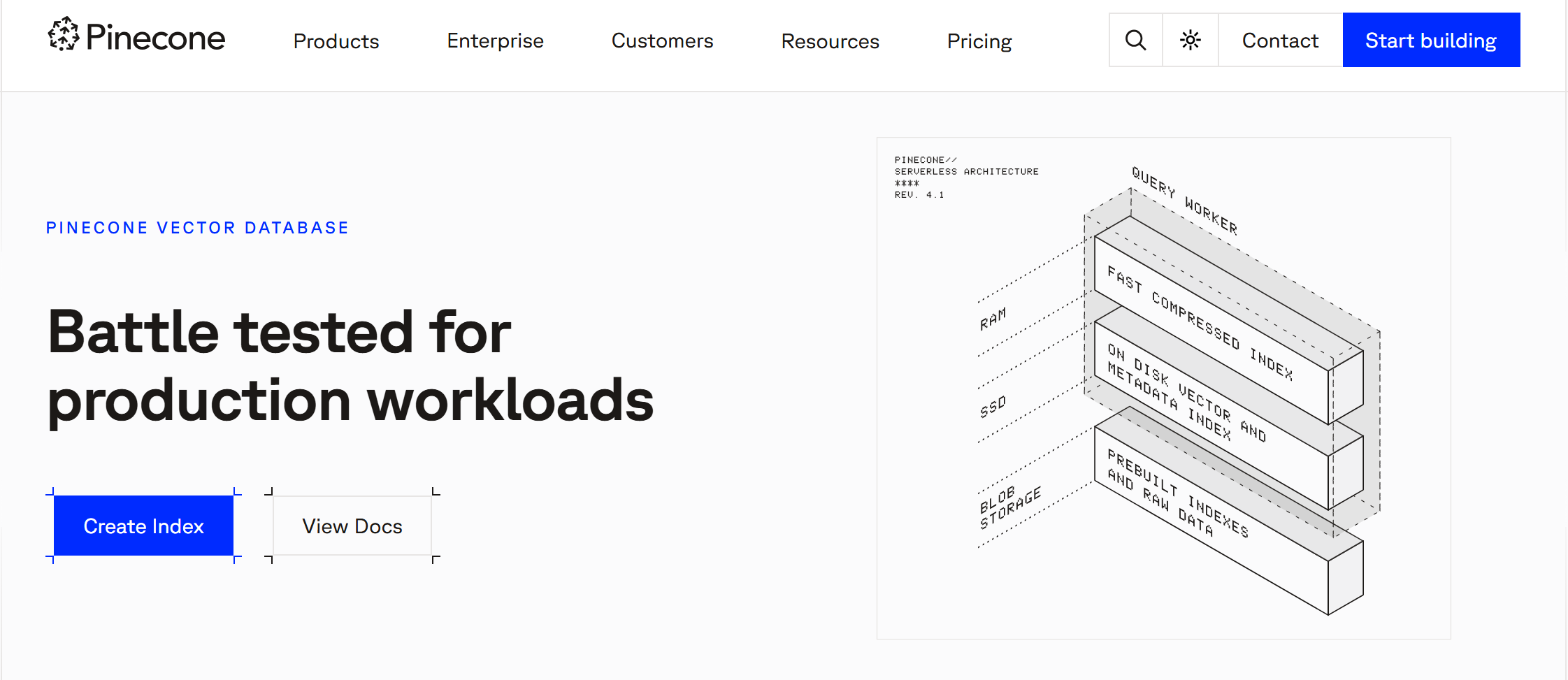
- Architecture Type. Based on this criterion, VDBs are divided into two types: serverless (pay-as-you-go, automatic scaling, suitable for both intermittent and high loads — for example, Pinecone Serverless) and dedicated (fixed resources, predictable latency, optimal for consistently high traffic).
- Supported data types. The more tasks an application performs, the more data types its vector database must handle. Support for high-dimensional data is a key feature of professional solutions in this area.
- Search methods. AI services, recommendation systems, and other modern products require complex search strategies, which the VDB must support. These include similarity search, filtering, grouping, hybrid search, personalization, and more.
- Data changes and synchronization. When choosing a VDB, it's important to consider the frequency of data changes and the method of synchronization. Some systems require custom code to update embeddings, while others offer simpler solutions.
- Scalability. Vector databases can scale horizontally by adding more nodes to the cluster to increase capacity and throughput. Reliable vendors allow you to test the scalability of their products by processing millions, tens of millions, and even billions of records.
- Ecosystem. The best platforms have a vast ecosystem of extensions and integrations with third-party tools. These include solutions for data management and monitoring, backups, capacity planning, diagnostics, as well as language models, ML frameworks, and embedding services.
In practice, different providers implement these parameters differently, so their solutions vary significantly in capabilities and performance in real-world scenarios. Below is a brief overview of the most popular VDB providers.
Pinecone
One of the most popular fully managed VDB solutions. It provides scalable similarity search functionality via a low-latency cloud API. It is widely used to optimize AI and RAG processes. It is integrated with popular embedding models and ML tools.
Milvus
This open-source distributed VDB supports various indexing methods and provides SDKs for Python, Go, Java, and other programming languages. It easily scales to handle large datasets. It's available both as open-source and through Zilliz Cloud hosting.
Weaviate
The open-source VDB is designed specifically for interoperability with AI services and applications. Built-in vectorization enables real-time embedding generation. It supports hybrid search and multimodal data types.
Qdrant
This open-source vector database is designed for high-performance workloads and supports filtering and hybrid queries. It's suitable for both cloud and on-premises deployments.
Built-in cloud services and enterprise database solutions
Major cloud providers offer vector search and indexing capabilities. For example, Azure Cosmos DB and Azure AI Search support vector search alongside traditional query functions, integrating seamlessly with the Azure AI stack.
Amazon OpenSearch Service supports k-NN vector search, and Aurora PostgreSQL can use vector extensions for embedding indexing. Enterprise databases like MongoDB Atlas include vector search capabilities, enabling semantic search integrated with documents and operational data.
Pgvector and PostgreSQL extensions
Over the past few years, a defining trend has been the native integration of vector search into traditional databases. The pgvector extension for PostgreSQL allows vector storage and similarity search directly within a relational database without requiring separate infrastructure. This solution is popular among teams already using PostgreSQL and not ready to support a separate vector service. Similar capabilities are offered by Redis Vector Search and the built-in vector search in Elasticsearch.
Conclusion
Vector databases have set a new standard in data storage, retrieval, and processing, significantly increasing the speed and accuracy of a range of data-related tasks and processes. These tools have found widespread use in modern AI services and applications, proving effective in a variety of scenarios: from natural language processing and visual content search to recommendation systems and anomaly detection.
The availability of specialized providers and solutions on the market makes it easy to select the optimal vector database for the specific tasks and needs of your software product. Furthermore, technology in this area continues to evolve, and the capabilities of such systems are gradually expanding in line with the growing requirements of AI applications.