The rapid development of artificial intelligence lately has introduced several challenges for AI models. One of these is updating AI data without retraining. RAG technology is designed to address this challenge. In this article, we'll discuss how it helps overcome the problem of data obsolescence in LLM knowledge bases and the principles of knowledge retrieval systems. You'll also learn the differences between Retrieval-Augmented Generation and fine-tuning methods and how RAG reduces AI hallucinations using data-driven approaches.
Static Intelligence vs. Dynamic Knowledge
Large language models (LLMs) are based on datasets loaded into them during development. The static nature of this data means that the model's output quickly becomes outdated. This is typical for LLMs operating without connecting to external data sources, such as the basic versions of GPT-3, GPT-3.5, and early versions of GPT-4 without search tools.
Traditional models have a fixed set of parameters and could not automatically incorporate new data into their knowledge base. They are characterized by generalized patterns of knowledge acquired during training and fine-tuning.
The lack of up-to-date knowledge in language models created problems with the accuracy and relevance of the data they stored. This has driven the industry to develop new approaches to LLM optimization. This technology is called Retrieval-Augmented Generation (RAG).
The new approach was first presented by Meta AI researchers in 2020 in the paper "Retrieval-Augmented Generation for Knowledge-Intensive NLP Tasks," published at the NeurIPS 2020 conference. The authors of the paper are Patrick Lewis, Ethan Perez, Alexandra Piktus, and others.
The RAG approach is considered a key method in the development of artificial intelligence. It allows developers to update their LLMs' knowledge base with new data after they have been deployed. This makes it possible to connect models directly to news portals, social media, and other online sources in real time.
Thanks to retrieval augmentation, the accuracy of information provided by LLMs significantly increases. Along with a generated response, the model can provide citations and links to sources, thus confirming the relevance of the data and providing additional information.
RAG technology enables more efficient AI deployment, helping developers better test and improve their AI-powered applications (e.g., chatbots). It allows you to monitor and modify the sources of information supplied to LLMs, restrict the model's access to sensitive data, and quickly correct or remove incorrect or outdated information.
The advent of the RAG methodology significantly expanded the capabilities of modern language models, increasing the accuracy and reliability of AI algorithms. Extracting relevant information from external sources in real time allows LLMs to generate accurate, context-sensitive responses without constant retraining.
Augmented generation has paved the way for the broader adoption of AI applications in dynamic and data-rich enterprise environments. It enables LLMs to adapt more quickly to rapidly changing information landscapes while maintaining security and compliance with industry standards.
The Mechanics of Retrieval: How RAG Works
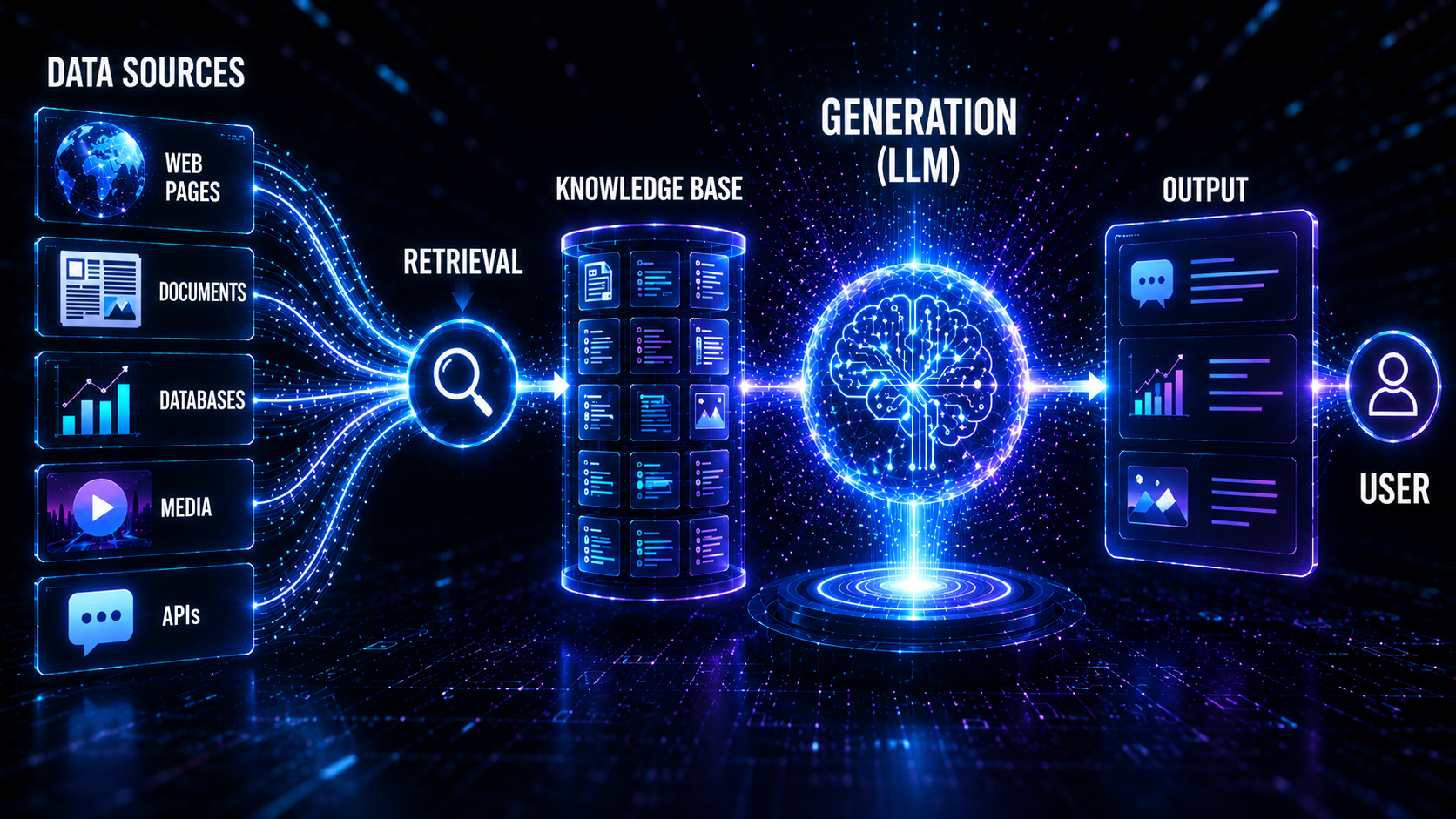
Without RAG technology, AI models generated responses to user queries based solely on their own training data. The lack of necessary information in the dataset meant that the LLM was unable to formulate a complete response or provided incorrect information (hallucinations).
The AI model with RAG works differently. Now, its main steps after receiving a user request look like this:
- External data input. LLM accesses external data sources (databases, APIs, document repositories, websites, etc.), collecting relevant information and using it as additional context to generate a response.
- Pre-processing and fragmentation. AI algorithms clean and structure data, removing duplicates and irrelevant fragments. At this stage, the system also fragments large materials, breaking them down into smaller pieces for faster searching.
- Vectorization and indexing. Using the embedding model, the query is transformed into a vector — a numerical representation reflecting its semantic meaning. Indexing organizes vectors into a searchable structure to improve the accuracy and speed of data processing.
- Extracting relevant data. The system searches vector databases for information matching a query, determining its relevance based on mathematical vector calculations and representations.
- Context injection. Context injection in LLMs allows the model to supplement its original knowledge with new information obtained from external sources. This provides the LLM with a hint for generating a more accurate and complete response.
- Response generation. In the final stage, the language model generates a response based on its own knowledge, the user's request, and context extracted from external sources.
RAG systems often utilize semantic search technology, a key component of the vectorization and search stages, with language models. Using vector representations, the system finds relevant content even when the query and document are formulated using different words.
RAG vs. Fine-Tuning: Efficiency and Cost-Effectiveness
Retrieval-Augmented Generation and fine-tuning approaches are used to solve similar problems of improving the response quality of language models. The key differences between them lie in their underlying mechanisms, which lead to different results depending on the application context.
The RAG method is based on updating language model data in real time through integration with external sources when processing a user request. Thus, LLM data is updated dynamically.
Fine-tuning uses a different approach: optimizing AI parameters through the targeted introduction of additional training data. Developers train the model on specific examples and adjust its behavior by feeding structured data into the LLM. This method does not enable automatic learning from new data, so the model data remains static until the next retraining stage.
To understand the differences between RAG and fine-tuning, it's worth understanding how they work, how complex they are to implement, and how they impact performance, scalability, and security. This will help you choose the most appropriate method for your specific needs or decide whether to use both.
Data relevance
Retrieval-augmented generation allows the model to independently extract data from external sources as needed. Continuous collection and processing of new data through real-time AI updates makes RAG an optimal choice for scenarios with rapidly updated information flows.
Fine-tuning only updates the model's knowledge base when it is retrained, initiated by developers or LLM administrators. This method limits the model's access to up-to-date data, so it will provide users with potentially outdated information until the next retraining session.
Complexity and cost of implementation
Retrieval-Augmented Generation requires the creation of a vector database, document storage, or other data sources, as well as the development of a search engine with embeddings and the implementation of solutions for integrating these components. Fine-tuning requires both prepared datasets and powerful infrastructure (GPUs, TPUs) for regular retraining of models.
Fine-tuning LLMs is a resource-intensive and costly process, requiring significant investments in computing systems. RAG reduces the cost of retraining models, which is especially important when using multiple LLM versions or scaling the workloads they perform.
Performance
A finely tuned AI model typically performs tasks better and provides more accurate, detailed answers to queries specific to its learning domain. Furthermore, it often produces a more consistent output style and format.
RAG improves the accuracy of LLMs across a broader domain. However, the quality of its answers depends not only on the completeness and relevance of additional data sources but also on the ability of the underlying model to account for context.
Scalability
RAG significantly accelerates and simplifies scaling the scope of a language model. This is achieved by dynamically incorporating more data sources or documents into the search process in real time.
Fine-tuning requires new training cycles to handle larger domains or support multiple models. This complicates and limits the scalability of LLM in rapidly changing environments.
Combined use
RAG and fine-tuning are not mutually exclusive approaches. Retrieval-Augmented Generation provides access to relevant external data in real time, but does not adapt the model's style and terminology to a specific domain. Fine-tuning, on the other hand, builds an in-depth understanding of the subject area but does not address the problem of data obsolescence.
Since 2024, hybrid solutions combining both methods have been increasingly used in enterprise AI systems: light fine-tuning ensures the accuracy of terminology and style, while the RAG layer ensures the freshness and verifiability of the data.
Reducing Hallucinations With Grounded Data
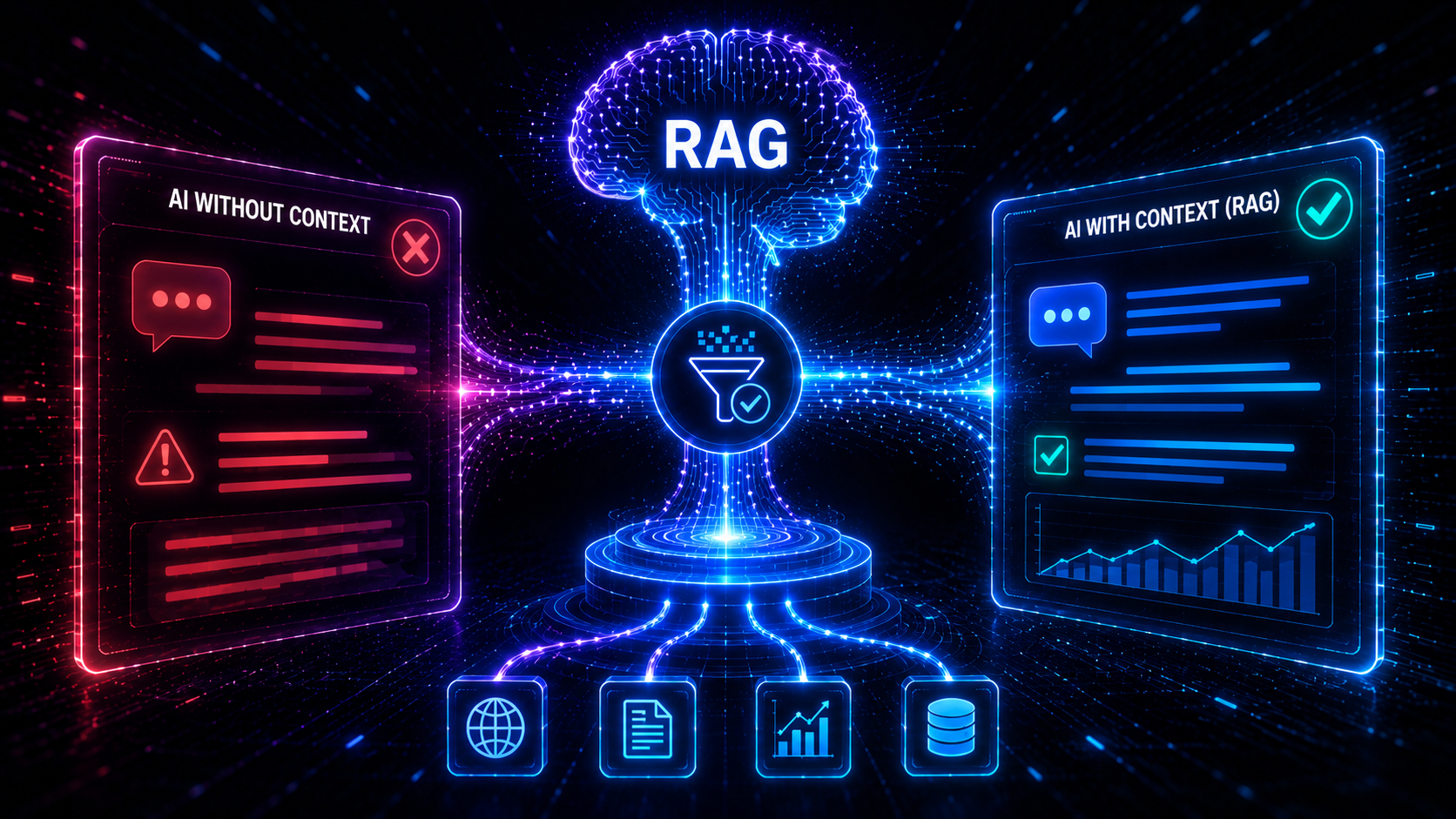
One of the most powerful advantages of the RAG method is its ability to improve the quality of responses produced by an AI model. This is crucial, as without external context, language models can generate inaccurate or fictitious responses.
Large language models generate responses to user queries by predicting the next token based on patterns they learned during training. Without access to external sources, they can't verify the relevance and accuracy of their own data, so they often produce plausible but distorted or completely incorrect answers, commonly known as AI hallucinations.
RAG technology adds a step to the model pipeline: searching for information in third-party sources (vector databases, document repositories, and online sources), not just its internal parameters. This significantly improves the accuracy of the model's output. Thanks to this, users receive grounded AI responses supported by real facts, quotes, and links to sources.
Optimizing language models using the RAG method significantly reduces the incidence of LLM hallucinations. The following tactics help achieve the desired result:
- Reducing knowledge gaps. The model does not need to infer missing facts.
- Providing verifiable context. The authenticity of responses can be verified against actual documents or other external sources.
- Providing source attribution. LLMs may provide document identifiers and source links in their responses.
- Limiting reliance on internal reasoning alone. The model compares the accuracy of its answers with verified resources in real time, rather than relying solely on its own knowledge.
Relying on verified data allows for increased overall reliability of the model's responses. Therefore, using RAG can reduce errors and make the AI model's results more predictable.
Conclusion
RAG opens a new chapter in the development of modern AI algorithms, making their knowledge dynamic and continuously updatable. This technology has successfully solved the long-standing problem of data aging in language models. Furthermore, it simplifies the scaling of their resources as the number of LLMs or the range of tasks they perform expands.
Using RAG optimization, AI developers have managed to significantly reduce the frequency of artificial intelligence hallucinations. However, complete elimination of this phenomenon remains impossible today, as the quality of results depends on the completeness and relevance of data sources, as well as the configuration of the retrieval system.
Read more on our blog:
- Content Atomization: Repurposing Long‑Form Content into Micro-Assets
- Mastering Firebase: Unlocking the Power of Google’s App Platform
- 5 Best Heatmap Tools for Website Conversion Optimization
- Google Lead Form and Asana Integration: Automatic Data Transfer
- How to Integrate TikTok with GetResponse: Step-by-Step Guide