Saving time with AI doesn’t necessarily mean a tool pays for itself. This article explains how to measure the ROI of AI tools at work, distinguish financial returns from operational gains, and account for overlooked costs when auditing the tools your team uses.
Hard vs. Soft ROI: Categorizing AI Gains
Hard ROI reflects measurable financial gains, such as lower contractor spending or savings from replacing a paid service. Faster lead processing alone does not show that customer acquisition costs have fallen.
Soft ROI covers operational gains that can often be measured but are harder to express in financial terms. It can include faster prototyping, more accurate support responses, or simply reduced employee burnout as people spend less time on repetitive tasks. However, "soft" metrics alone do not pay for the subscription. For these benefits to translate into real financial gains, businesses need to focus on measuring AI productivity regularly and linking it clearly to business results.
The Core Formula for Calculating AI ROI
Use this formula to see whether an AI tool’s financial benefits outweigh its costs:
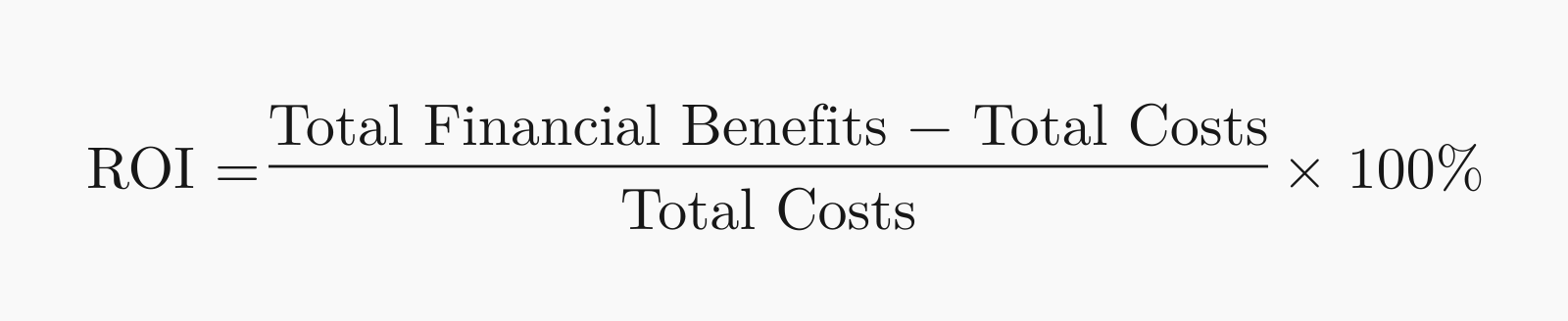
The difficulty lies in detailing each of the elements of the equation:
- Financial benefits. Count documented cost savings and any additional profit attributable to the tool before deducting the AI costs listed below. Report hours saved separately. If those hours lead to a measurable financial gain, count the gain without also assigning a dollar value to the same hours.
- Total costs. Include subscription fees and AI implementation costs such as setup, onboarding, and training. Account for API usage, maintenance, and error recovery where applicable.
When calculating AI savings and ROI, measure benefits and costs over the same period.
Hidden Costs and AI Measurement Pitfalls
The most common mistake that can throw calculations off balance is ignoring hidden costs. On paper, everything looks great, but in real life, implementing AI creates a lot of unexpected costs:
- Review and rework time. Fact-checking, editing, and correcting AI-generated work can reduce or erase the time saved.
- Unused licenses (shelfware). Check how many paid seats your team actually uses before renewing.
- Error recovery costs. Incorrect outputs or failed automations can require manual intervention and add costs, especially if they affect customers.
Only by taking these pitfalls into account can you accurately measure AI ROI and understand the team's actual performance rather than rely on misleading assumptions.
Step-by-Step AI Audit Framework for Teams
When evaluating AI tools at work, follow these three steps:
- Establish a baseline. Before purchasing another subscription, track the actual time and money your team spends on typical tasks right now.
- Measure usage and results. Use activity logs to see who uses the tool. Then compare similar tasks completed with and without AI. Track both output quality and total time, including review and rework.
- Take regular snapshots. A monthly audit gives you a clear understanding of whether to continue your subscription, reduce the number of licenses, or abandon the service altogether.
Conclusion
Measuring the actual AI return on investment is not a one-time exercise conducted during a trial period but an ongoing process. Only a systematic approach helps to notice budget drains in time and redirect resources to those technologies that really bring benefits. In today's business environment, companies that regularly review their software stacks and retain only tools with measurable business value will be better positioned to control costs and make informed technology investments.