
To launch modern websites and applications, developers no longer need to interact with servers and other traditional web hosting infrastructure. These have been replaced by cloud-based serverless systems, capable of flexibly automating all stages and aspects of web project deployment. In this article, we'll discuss one of the most well-known and sought-after of these services. You'll learn what Vercel is used for, its key features, architecture, the solutions it offers, and its pricing structure.
Introduction to Vercel
So, what is Vercel? It's a developer platform that provides a set of tools and cloud infrastructure for creating, deploying, and maintaining websites and dynamic web applications. It enables professionals to efficiently implement high-performance frontend and backend processes with minimal manual intervention and extensive capabilities for scalability and customization.
Vercel is highly sought after as a web hosting provider for projects of various types and scales. Specifically, it provides ready-made solutions for deploying AI services, e-commerce platforms, marketing websites, multi-user platforms, and other types of software.
The platform is ideal for deploying websites and applications built using currently popular frameworks (such as React, Next, Vue, Svelte, Astro, etc.). Many developers consider it one of the best hosting options for Next.js.
Vercel offers developers a number of advantages over traditional server-based web hosting. Key among these are its simplicity and versatility, allowing for the optimization and automation of all deployment stages using Git integrations.
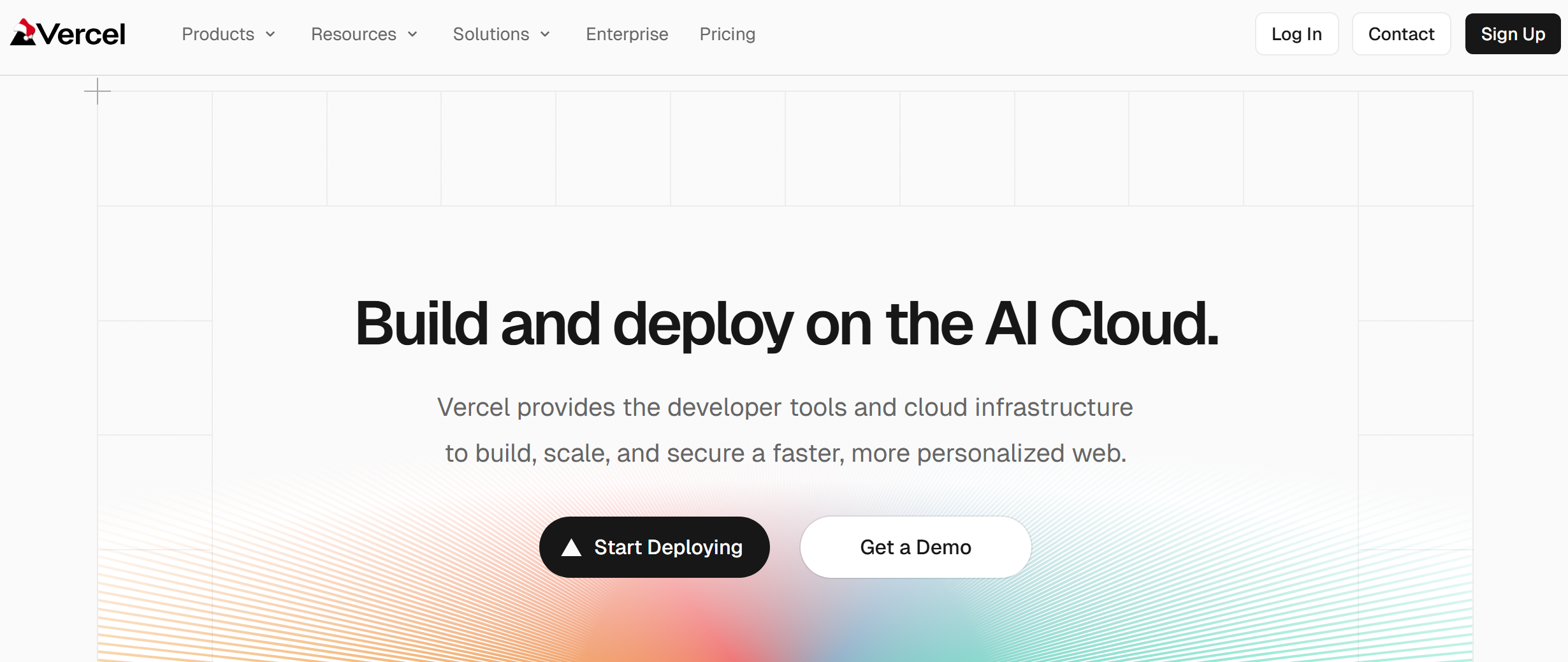
Source: vercel.com
This system significantly reduces infrastructure setup and deployment time thanks to automated CI/CD and Git integrations, and it improves the speed and performance of web projects through support for a global content delivery network (CDN). Equally important advantages include autoscaling thanks to its serverless architecture and usage-based pricing.
Vercel hosting tools are used by many popular web resources with millions of users. These include Adobe, Notion, Stripe, Box, Calendly, Patreon, Nintendo, Twilio, TikTok, and others. Vercel partners with AWS, GitHub, Salesforce, Shopify, MongoDB, and a number of other major tech companies.
Core Features and Developer Tools
Vercel provides efficient deployment and support for serverless and edge functions, enabling the creation of high-performing and secure web applications. Below are the key platform mechanisms that simplify project development and scaling.
Continuous Deployment
Vercel efficiently automates website and web app deployment processes thanks to native integrations with GitHub, GitLab, and Bitbucket. It also allows you to use any code repository for these purposes using the Vercel CLI.
The platform supports JAMstack deployment — a popular web development method based on the principles of pre-rendering and decoupling. This architecture helps easily create performant, fast, and secure web resources based on three components: JavaScript, APIs, and markup languages (HTML/CSS).
Serverless Functions
Vercel’s architecture supports serverless functions, which handle API requests and backend operations. It also provides edge functions, a lightweight runtime designed to perform low-latency tasks closer to the user for improved performance.
Vercel's serverless features eliminate the need to manage traditional servers when deploying websites and web applications. Instead, the platform provides cloud-based access to these tools, simplifying the development process and allowing developers to focus on business logic and other important aspects of their software.
Edge Functions
Edge functions allow developers to run server-side code without having to manually manage servers. They support automatic tuning based on current load, provide improved parallelism, and handle database connections via API.
Edge Vercel features demonstrate high efficiency when solving AI projects or other I/O processes that require fast and high-quality scaling. They ensure minimal latency and stable performance even under heavy loads.
During software deployment, the platform automatically selects the necessary tools and optimizes them specifically for the specific framework. As a result, websites and applications load with reduced latency thanks to CDN traffic routing and data hosting in a region close to users.
Monitoring and Analytics
Vercel also provides a powerful set of native tools for monitoring and analyzing key metrics for the websites and web applications it hosts. Specifically, it allows you to track infrastructure performance in real time, gain traffic insights, and identify and diagnose potential issues. Furthermore, the platform allows you to analyze and visualize the performance of each software function across all environments using built-in dashboards and execution logs.
AI Infrastructure and Tools
Vercel provides comprehensive AI infrastructure specifically designed for building and deploying AI-powered applications with minimal configuration.
AI SDK — An open-source toolkit for TypeScript and JavaScript that simplifies integration of AI models into web applications. The SDK enables developers to effortlessly stream long-running LLM responses, improving user experience with zero-config infrastructure that maintains global performance.
AI Gateway — A unified interface that provides developers with effortless access to hundreds of AI models from multiple providers, including OpenAI, Anthropic, xAI, and many others. The gateway simplifies model deployment and management, allowing developers to switch between different AI providers through a single endpoint.
Vercel Agent — An intelligent agent that understands your tech stack and can execute complex workflows, delivering more value to users by automating sophisticated tasks within your applications.
Fluid Compute — A flexible compute model designed to handle all workloads, including AI applications. It uses Active CPU pricing to ensure efficient resource utilization and cost optimization for both traditional web apps and AI-intensive operations.
These AI tools integrate seamlessly with Vercel's infrastructure, enabling developers to build, deploy, and scale AI-powered features without managing complex backend systems.
Performance and Scalability
Vercel delivers high-performance and automatic scaling for web applications, minimizing latency and optimizing performance even under peak loads. The platform utilizes a global server network and intelligent caching mechanisms to accelerate content delivery to users. Let's explore the key tools and technologies that make this possible.
Global Edge Network
The Vercel Edge Network (CDN) can dramatically increase the speed and performance of dynamic web applications. The global CDN network has numerous points of presence, while code execution occurs across dozens of regions worldwide, ensuring low latency and high performance.
This option helps the system automatically determine the server closest to a specific user and use it to deliver content. CDN Edge minimizes latency, improves reliability, and accelerates web application loading without requiring developers to make any manual configurations.
One of the key features of the Vercel CDN is multi-tiered content caching, which is performed automatically at the browser, edge, and origin levels. The system also supports automatic image optimization (resizing and compressing files), and its ISR feature allows for updating static content without requiring a complete rebuild.
Scaling
Vercel's backend and frontend cloud platform automatically scales the functionality of websites and applications deployed on it. This ensures high performance even under peak loads.
The platform automatically scales applications based on load and the chosen plan, using fluid concurrency and Active CPU management to ensure consistent performance under varying traffic conditions. Scaling is based on a peak parallelism limit of 1,000 concurrent executions per 10 seconds per region. Enterprise plan customers can also purchase extended limits.
Vercel's infrastructure automates resource monitoring and promptly adjusts limits based on current traffic volumes. This allows websites and applications to flexibly and quickly scale their functionality without developer intervention.
Pricing and Plans
To conclude our review, we'll discuss whether Vercel is free or not. Indeed, the platform offers a free plan with limited functionality, as well as several paid plans with more extensive features.
Vercel pricing includes the following options:
- Hobby (repository import, automated CI/CD, web application firewall, global automated CDN, DDoS protection, traffic and performance insights) — free plan for small projects.
- Pro (all Hobby features + advanced expense management, collaboration tools, accelerated builds without queues, cold start protection, enterprise add-ons) — $20 per month + resource volume pricing.
- Enterprise (all Pro features + team and guest access control, SCIM & Directory sync, managed WAF rulesets, multi-region computing and fault tolerance, 99.99% SLA, extended support) — price upon request.
Conclusion
To summarize our Vercel review, it's worth noting that this cloud platform is rightfully considered a true game-changer for modern web development. It dramatically simplifies and accelerates routine software deployment processes with Git integrations, extensive frontend/backend support, a high-performance CDN, data protection tools, and a host of other advantages.